AASHTO Enterprise
Risk Management Portal
Browse the latest documents, videos, tools, trainings, and events for the ERM community.
Check out the Resilience Improvement Plan (RIP)Resource Collection
&
Stop by the CPBM Subcommittee on Risk Management community page
Check out dotriskmgmt.com, a research product from NCHRP 08-151, Risk Management at State DOTs: Building Momentum and Sustaining the Practice.
Check out materials for the 2025 National TAM Conference, taking place Aug 25-28 in Chicago, Illinois
We would love to hear your suggestions and feedback, so please Provide Site Feedback for anything you think can be enhanced or improved!
Connect
Connect
Sign up for monthly updates
About the site
The AASHTO ERM Portal connects you to a searchable database of enterprise risk management resources: documents, presentations, events, tools, and more. The portal is designed to help enterprise risk management practitioners search and access relevant information from multiple sources.
NCHRP Reports
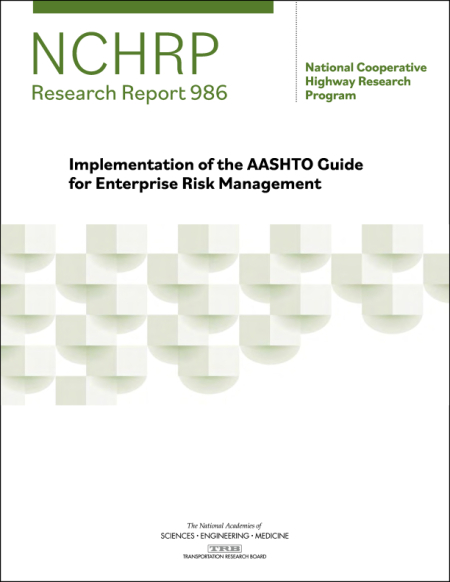
Implementation of the AASHTO Guide for Enterprise Risk Management | Research Report
This report presents pilots with three different agencies as they applied the strategies and practices identified in the AASHTO Guide for Enterprise Risk Management and smaller case studies from several more agencies. Many agencies mitigate risk on a daily basis without realizing or formalizing the process. This study seeks to raise awareness for systematic risk management across the agency including a risk community of practice, peer exchanges, webinars, and outreach. Checkout the report to learn more about the process of risk management and how it helped out these agencies. Alongside the report, the researchers also produced a presentation, a risk assessment tool, a budget template and a webinar video, all available from the external link.
Document
Reducing Greenhouse Gas Emissions: A Guide for State DOTs | Research Report
Emissions, EnvironmentThis WebResource describes methods State DOTs may implement to assess and reduce their GHG emissions. The resource includes self-assessment tools, an overview of climate change issues, a framework for addressing GHG emissions, and numerous resources and links. The report organizes around nine functional areas of the agency, with cross-cutting topics to pull it all together. Through the discussions, tools, and resources in each section, the report provides support for reducing emissions across all stages of a project, from policy and planning to construction and maintenance. It also reviews stakeholder communication, partnerships with other agencies, and federal or state requirements. Readers may use this guide and its flexible presentation for addressing specific areas within an agency or to adopt an agency-wide approach.
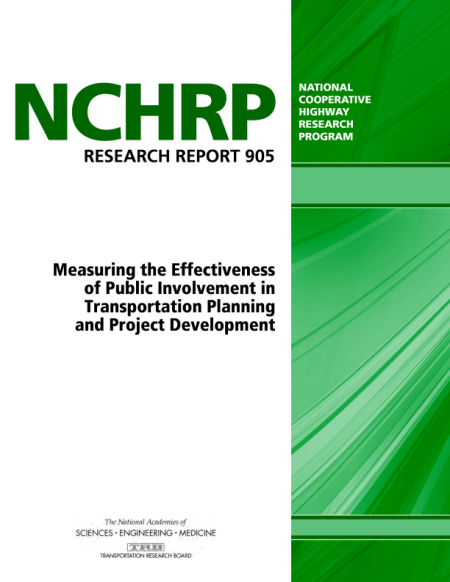
Measuring the Effectiveness of Public Involvement in Transportation Planning and Project Development | Research Report
Organizational ManagementThis research report develops a toolkit for transportation practitioners to measure the effectiveness of an agency's public involvement. A score is developed based on a couple different indicators and the agency's own perceptions. The toolkit may be used to compare different public involvement strategies and track an agency's performance over time.
Document
NCHRP Synthesis 667: Identifying Risks and Incorporating Them into Bridge Asset Management Planning
Departments of transportation (DOTs) manage extensive bridge inventories while facing increasing pressure from aging …
Thermal Protection System Evaluation for DOT-117 Hazardous Materials Car Tanks
The Federal Railroad Administration sponsored a research team from Engineering Services, Inc. to perform an analysis …
SPR-FY25(041): The Effect of Nighttime Lighting on Construction Workers' Safety
This research evaluated the effectiveness of nighttime construction lighting systems in improving worker visibility a…
Video
Search across Documents, Tools, and Videos in the Resource Library
Collections
Browse the latest collections